

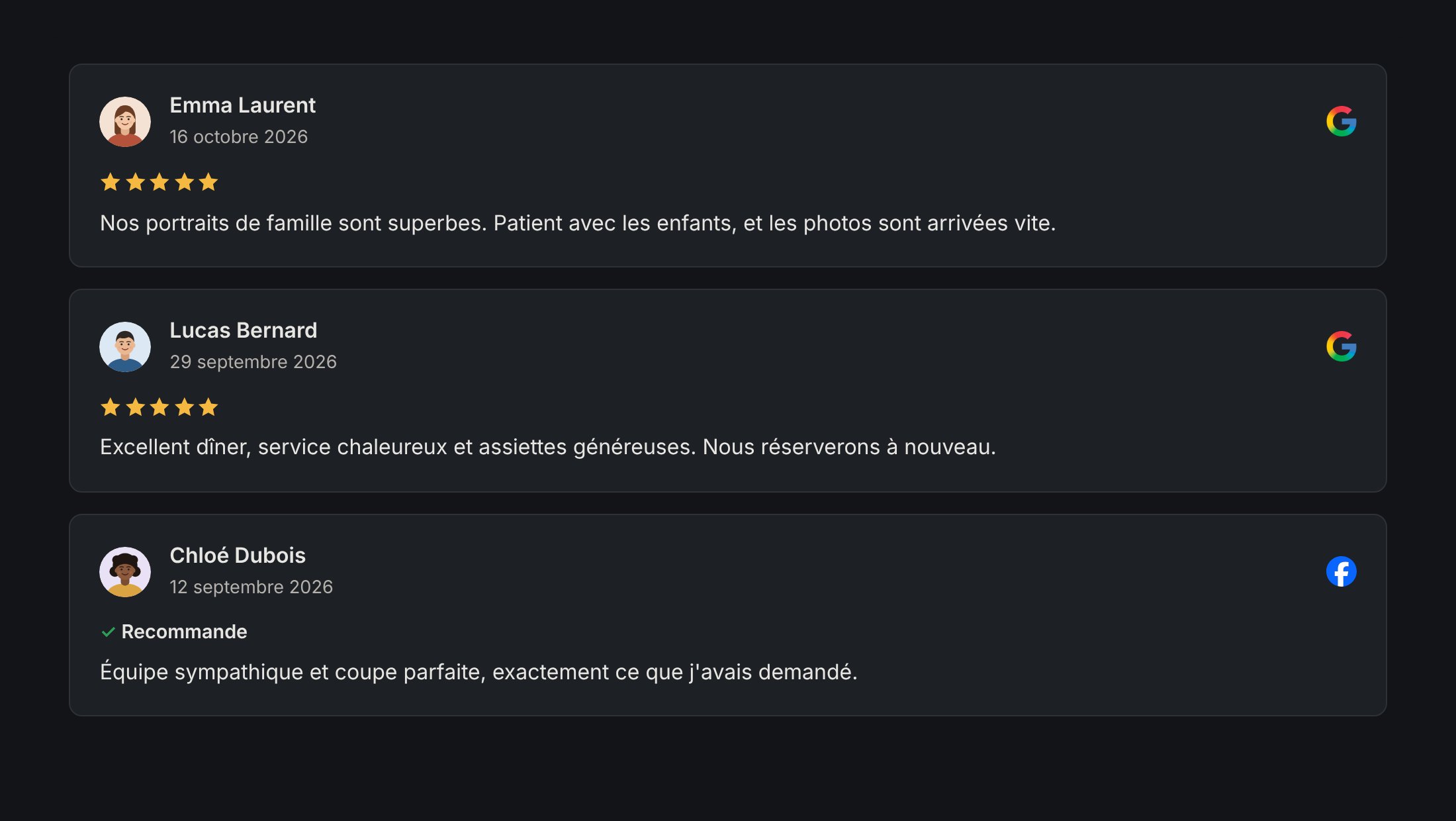
My customers leave reviews in several places. On Google, because that is where people look for a photographer. On Facebook, because they are already there. On specialised directories, because that is where weddings are planned.
For years my site showed only part of those reviews. One page displayed the Google reviews. Another, in a different section, displayed those left elsewhere. Never all together. A visitor who landed on the wrong page saw six testimonials instead of forty, and left with a false idea of my work.
That was not a choice. It was the consequence of having installed two different tools, each able to do one thing.
Bringing those reviews together sounds simple. In practice it raises three questions that deserve an honest answer, and it took me a while to find mine.
First question: in what order?
This is the most important question, and the one people ask themselves least.
The temptation is obvious: five stars first, the most glowing at the top, the oldest at the end. Many tools offer it, sometimes as a paid feature.
I recommend the opposite: chronological order, newest first. For three reasons.
The first is that sorting by rating shows. A visitor scrolling through twenty flawless testimonials, in an order that matches no logic of date, senses that they are being shown a selection. A chronological run, with its peaks and its quiet spells, looks like a real business.
The second is that chronology tells you something. You can see there were customers in January, in March, in June. You can see the business is alive. Sorting by rating erases that information entirely.
The third is legal, and I develop the point in the next article: in several countries, including France, if you sort reviews by anything other than date, you must say on what criteria. Sorting by rating, declared, is allowed. Sorting by rating, hidden, is not.
Second question: which average rating?
This is where it gets complicated, and where you can cheat without even noticing.
Your platforms do not rate in the same way. Google uses five stars. Specialist directories do too, but often with several criteria averaged together. Facebook, for years now, has not asked for a rating but a yes or no question: do you recommend this business?
Averaging all of that has no mathematical meaning. Turning a Facebook recommendation into five stars is an arbitrary choice that nothing justifies, and it mechanically inflates your average.
What I do, and what I advise:
- The average covers only the reviews that are actually rated. Recommendations without stars are counted separately, and announced as such.
- The number of reviews you state matches the number you display. This sounds obvious. Many sites announce “over 200 reviews” while showing ten.
- If a review is excluded from the calculation, for a legitimate reason such as abusive content or personal data, say so. A discreet counter is enough.
An honest average is lower than an arranged one. It is also far more credible, and it exposes you to nothing.
Third question: what about sources that look nothing alike?
A Google review runs to three lines. A specialist directory review can run to twenty, with per-criterion ratings. A Facebook recommendation has neither title nor rating. Profile photos exist on one and not the other.
Placed side by side without thought, the result is a page in disarray, where each block looks as though it came from a different website. That is exactly what I had on my site, and it was ugly.
The answer is a single presentation that does not depend on the source. Same card, same typography, same way of showing the date and the name. The source is still shown, because that is honest and useful information, but as a small logo or a discreet mention, not as a different layout.
The point is not to make everything look as if it came from one place. The point is for the visitor to read testimonials, rather than a row of tools.
A detail that matters: the reviews you cannot reach
There is something to know before you start: you cannot retrieve everything.
On Facebook, a recommendation written by someone whose profile is private is visible only to their friends. It is supplied to no application whatsoever. If a tool promises to retrieve 100 % of your Facebook recommendations, it is mistaken or it is lying.
In the same way, each platform decides what it exposes. Some offer official access, some do not. A tool that goes looking for reviews where the platform does not provide for it exposes you to the whole thing breaking overnight, and sometimes to breaching that platform’s terms of use.
An incomplete but solid set beats a promise that will last six months.
And consistency over time?
One last point, often forgotten: your reviews will keep arriving, on all your platforms, without warning.
If bringing them together takes manual work, you will do it once and then never again. Six months later your page will show a frozen snapshot of your business, with the latest review dating from last winter. That is worse than showing nothing: it signals a business that has stopped.
Automatic synchronisation is not a luxury. It is the condition for the whole thing to stay true.
What I use
It was this precise problem, and no other, that made me build Magnetic Stars. I wanted one presentation for all my sources, in chronological order, updating itself, without my visitors having to load anything from another site.
The plugin is free, with no cap on the number of reviews or on how often they are shown, because capping the number of displayed reviews, common among free tools, empties the idea of its meaning. Showing ten reviews out of forty takes you back to the original problem.
Key points
- Sort by date, newest first, unless you clearly announce another criterion.
- Average only what is actually rated, and say how many reviews the average covers.
- One presentation for every source, with the source shown discreetly.
- You will not retrieve everything, and that is normal: be wary of anyone promising otherwise.
- Without automatic synchronisation, your page goes stale within months.
In the next article: what the law actually requires on customer reviews, in France, in Europe and in the United States.